Starlink Aviation Tracker 2026: Every Airline, Every Aircraft, Every Route
Live tracker of every airline that has committed to SpaceX Starlink in-flight Wi-Fi — installation status, aircraft types, free-vs-paid access, and rollout timelines. Updated April 2026.
TL;DR — as of 26 April 2026
- 40+ commercial airlines have committed to Starlink, with a backlog exceeding 3,000 aircraft.
- Qatar Airways (~120 widebodies), United (300+ regionals + 500 mainline by EOY), and Hawaiian (full Airbus fleet) lead deployment.
- Free for all passengers is now the default model — only Vueling, LEVEL, and a few others kept Starlink behind a paywall.
- Notable holdouts: Delta picked Amazon Project Kuiper instead, American is still negotiating, Ryanair has no Wi-Fi plans.
- Real-world median speed: ~152 Mbps download / 24 Mbps upload / 44 ms latency (Ookla) — but per-passenger speed depends on aircraft load and antenna count.
👉 Check whether YOUR specific flight has Starlink Wi-Fi — type any flight number, get an instant probability with reasoning. Free, no signup.
This page is a live tracker, not a one-time post. We re-verify every airline's status monthly.

Why Starlink changed in-flight Wi-Fi
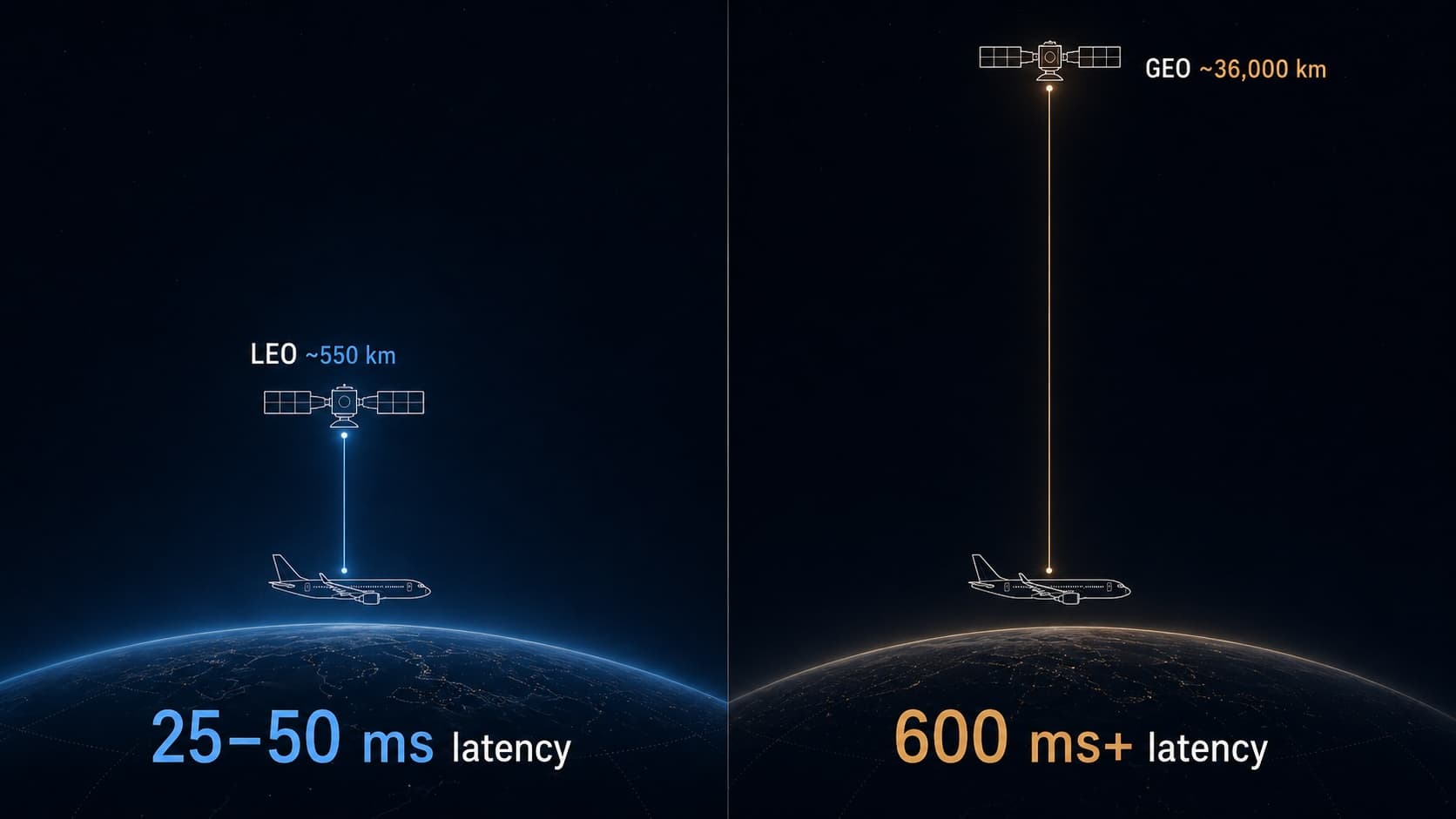
For two decades, in-flight Wi-Fi meant either slow air-to-ground service over land or expensive geostationary satellite links with 600+ ms latency. Starlink Aero uses SpaceX's low-earth-orbit constellation at ~550 km altitude, which collapses round-trip latency to 25–50 ms — usable for video calls, online gaming, and cloud apps that GEO satellites simply cannot serve.
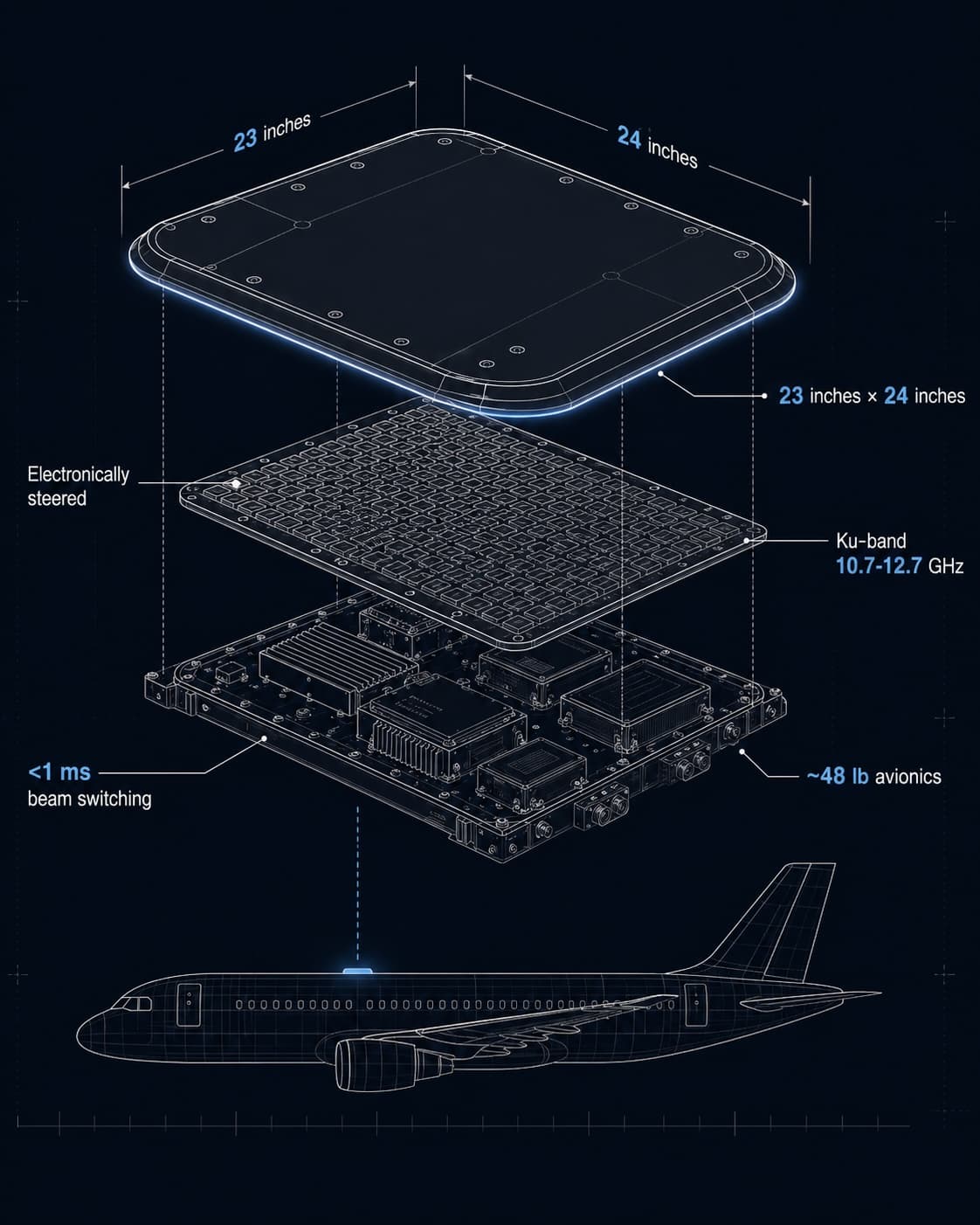
The economics also shifted. Starlink's per-aircraft hardware kit is roughly $150,000 plus install (FA Aircraft Sales), and the antenna is a flat 23"×24" electronically-steered phased array — no mechanical gimbal, lighter weight, lower drag. That made fleetwide retrofits financially viable for airlines who had previously kept Wi-Fi as a paid premium.
The result: the biggest in-flight connectivity migration in aviation history. This tracker maps where it stands.
The tracker — every airline with a public Starlink commitment
Sorted by total aircraft committed. Status reflects publicly verified deployments as of late April 2026.
| Airline | IATA | Region | Aircraft committed | Equipped today | Free for passengers? | Status |
|---|---|---|---|---|---|---|
| Lufthansa Group (LH, OS, LX, SN, EW, EN, WK, 4Y) | — | Europe | ~850 | 0 | Yes (all classes, all status tiers) | Rollout starts H2 2026 (source) |
| United Airlines | UA | North America | 800+ | 300+ regional + first 737-800s | Yes (free with MileagePlus signup) | 500 mainline target by EOY 2026 (source) |
| IAG (BA, IB, EI, LEVEL, VY) | — | Europe | 500+ | First BA 787-8 in Apr 2026 | Mixed: free on BA/IB/EI, paid on LEVEL/VY | First BA flight LHR–IAH Apr 2026 (source) |
| Southwest Airlines | WN | North America | ~800 (full 737 fleet) | 0 | Yes (Rapid Rewards signup) | First aircraft summer 2026; 300+ by EOY (source) |
| Korean Air / Hanjin Group (KE, OZ, LJ, BX, RS) | — | Asia | Fleetwide | 0 | TBD | Service start Q3 2026 (source) |
| Emirates | EK | Middle East | 232 widebodies (777 + A380) | First 777s Nov 2025; A380 installs Feb 2026 | Yes (all cabins, no Skywards required) | ~14 aircraft/month; full fleet mid-2027 (source) |
| Air France | AF | Europe | Entire fleet (A220, A320, A330, A350, 777, E170/E190) | ~30% of fleet | Yes (Flying Blue signup) | Full fleet target end-2026 (source) |
| Qatar Airways | QR | Middle East | All widebodies (~205) | ~120 aircraft (777 + A350 complete; first 787s in Jan 2026) | Yes (gate-to-gate, "Oryx Comms") | A350 fleet completed Dec 2025 in 8 months (source) |
| Copa Airlines | CM | Latin America | ~121 (737 fleet) | 0 | Yes | First Latin American carrier; service July 2026 (source) |
| WestJet | WS | North America | 737 + 787 fleet | First 737s in service | Yes (Rewards signup, TELUS-sponsored) | Widebodies complete by EOY 2026 (source) |
| Alaska Airlines | AS | North America | Mainline + 89 regional E175 | Regional fleet complete Q1 2026; first 737 mainline Apr 2026 | Yes (T-Mobile-sponsored) | Mainline fleetwide target end-2027 (source) |
| Hawaiian Airlines | HA | North America | A330 (24) + A321neo (18) + 787-9 (planned) | Airbus fleet complete since Sep 2024 | Yes | 787-9 install begins Fall 2026; 717s NOT included (source) |
| Virgin Atlantic | VS | Europe | A350, 787, A330neo | First aircraft May 2026 | Yes (Flying Club signup) | Fleetwide 2027 (source) |
| flydubai | FZ | Middle East | 737 + future A321neo | 0 | Yes | Rollout begins 2026 (source) |
| Gulf Air | GF | Middle East | Fleetwide (A320 + widebodies) | 0 | Yes | Mid-2026 launch |
| SAS | SK | Europe | Fleetwide | 0 | TBD | Rollout from mid-2026 |
| ITA Airways | AZ | Europe | Fleetwide | 0 | TBD | Announced Jan 2026 |
| airBaltic | BT | Europe | A220-300 (~50+) | 20+ aircraft | Yes | First European Starlink airline (Feb 2025) (source) |
| Air New Zealand | NZ | Oceania | Trial only — A320 + ATR 72-600 | Trial fleet | Yes (during trial) | World's first turboprop Starlink trial (source) |
| ZIPAIR Tokyo | ZG | Asia | 787-8 fleet (8 aircraft) | First aircraft Feb 2026 | Yes | Asia's first Starlink commercial flight (source) |
| JSX | XE | North America | Embraer ERJ-135/-145 (~100) | Active fleet complete since May 2023 | Yes | Starlink's launch customer for aviation (source) |
Business aviation (separate from commercial above): NetJets has signed for 600 aircraft (source) and Flexjet is in active rollout. Most major BizAv operators now offer Starlink as an option.
Notable holdouts
Delta Air Lines — picked Amazon Kuiper
Delta announced on 31 March 2026 that it will install Amazon Project Kuiper Leo connectivity on 500 aircraft starting in 2028, bypassing Starlink entirely (CNBC). In the interim Delta continues with Viasat and Hughes hardware. For travelers booking Delta in 2026–2027, expect GEO-satellite-class performance (slow, high-latency).
American Airlines — still deciding
American launched free Wi-Fi on its narrowbody and dual-class regional fleet in January 2026 with AT&T sponsorship using Viasat and Intelsat hardware — explicitly not Starlink (American). The airline confirmed in March 2026 that it is in active discussions with both SpaceX and Amazon (CNBC). No commitment yet.
Ryanair — no plans
Europe's largest low-cost carrier still has no in-flight Wi-Fi product. CEO Michael O'Leary's position remains that the economics do not work for short-haul European operations.
Aircraft compatibility — what is STC-approved
The Supplemental Type Certificate (STC) is FAA / EASA paperwork that says "this aircraft model is approved to fly with this antenna installed." Without an STC for your specific aircraft type, no Starlink — even if your airline has signed a deal.
FAA-approved (in commercial service):
- Boeing 737-800 (United STC, Sep 2025)
- Boeing 777-200LR / 777-300ER
- Boeing 787-8 / 787-9
- Embraer ERJ-135 / ERJ-145 / Legacy 600
- Embraer E170 / E175
- Airbus A220-300
- Airbus A321neo
- Airbus A330-200
- Airbus A350-900 / A350-1000
EASA-approved:
STC in progress (not yet flying with Starlink commercially):
- Airbus A380 — Emirates installs commenced February 2026 with 3 antennae per aircraft (industry-first)
- Boeing 737 MAX 8/9 — STCs in process at Alaska, WestJet, flydubai
- Boeing 737-700 / 737-900ER — In progress
Notably absent from any STC roadmap:
- Boeing 717 (Hawaiian retains for inter-island; no Starlink ever)
- Older 757/767 widebodies
How Starlink Aero compares to incumbents
| Metric | Starlink Aero (LEO) | Viasat (GEO Ka) | Inmarsat GX (GEO Ka) | Panasonic (GEO Ku) |
|---|---|---|---|---|
| Latency | 25–50 ms | 250–600 ms | 600–800 ms | 600+ ms |
| Per-aircraft bandwidth | 150–500 Mbps | 12–100+ Mbps | ~50 Mbps down / 5 Mbps up | 10–50 Mbps |
| Antenna form factor | Flat phased-array, ~48 lb avionics | Mechanically-steered radome | Larger Ka radome | Larger Ku radome |
| Satellite altitude | ~550 km | ~36,000 km | ~36,000 km | ~36,000 km |
| Capacity model | Shared across LEO constellation, grows with launches | Dedicated regional spot beam | Global Xpress beams | Multi-satellite Ku |
The latency gap is what travelers notice first. A Zoom call simply does not work over a 600 ms GEO link. It does over Starlink — so much so that several airlines (Qatar, Emirates) explicitly market video-call support as a headline feature.
Performance reality — what speed do passengers actually see?
Marketing claims and real-world experience diverge. Here is what independent testing has measured:
- Ookla median across multiple airlines: 152 Mbps down / 24 Mbps up / 44 ms latency (source)
- Per-aircraft peak (vendor claims): Qatar Airways and Alaska Airlines each cite "up to 500 Mbps per aircraft"
- Single-user median (academic study, transcontinental): ~64 Mbps download per device (arxiv.org, Aug 2025)
- JSX MacBook test (The Points Guy): consistent 200 Mbps across flight phases
What affects your actual speed:
- Passenger load — bandwidth is shared across the cabin. A full 777 yields lower per-seat speed than a half-empty one.
- Antenna count — Emirates A380 has 3 antennas; most aircraft have 1. More antennas = more concurrent capacity.
- Latitude — Starlink's constellation is denser at mid-to-high latitudes than over the equator.
- Time of day in the satellite's footprint — capacity from each LEO bird is shared with ground users below.
Practical takeaway: Plan for 30–80 Mbps per device on a typical full flight, with bursts above 100 Mbps. This is plenty for HD streaming, video calls, and file uploads. It is not symmetric to a fixed-line gigabit.
What to expect through end of 2026 and into 2027
Confirmed install plans drawn from press releases:
By end of 2026:
- United: 500 mainline + 300 regional aircraft (~800 total)
- Southwest: 300+ aircraft
- Emirates: 150 of 232 widebodies
- Air France: full fleet
- Qatar Airways: 120+ widebodies (already there)
- Hawaiian: full Airbus + first 787-9s
- Copa: majority of 121 aircraft
- IAG: BA + Iberia in progressive rollout
- WestJet: full widebody fleet
Through 2027:
- Alaska Airlines: full mainline
- Virgin Atlantic: full fleet
- Korean Air group: full fleetwide
- Emirates: full 232-aircraft fleet
2028 and beyond:
- Lufthansa Group: full coverage by 2029 (largest single deployment in Europe)
- Delta: 500 aircraft on Amazon Leo (Kuiper), not Starlink
Across all publicly announced commitments, the commercial airline backlog now exceeds 3,000 aircraft. SpaceX has separately disclosed it is the bottleneck on antenna manufacturing capacity, not airline demand.
How we built this tracker
WillItWiFi maintains every entry in this article from primary sources only. Here is our methodology:
- Source preference: airline press releases > SpaceX/Starlink press releases > regulatory filings (FCC, FAA, EASA) > established aviation trade press (Runway Girl Network, ch-aviation, Flightglobal). We avoid affiliate-driven travel blog rewrites.
- Status verification: "Equipped" counts come either from airline announcements or third-party fleet trackers. When sources conflict, we cite the most recent.
- Free-vs-paid classification: taken from the airline's own published policy, not press release marketing language. Loyalty signup requirements are noted explicitly.
- Update cadence: monthly review of all entries. The "Updated" date at the top of this page reflects the most recent verification pass.
- Conflicts of interest: WillItWiFi has no commercial relationship with SpaceX, any listed airline, or any competing connectivity provider.
If you spot an error or have an update, the contact link is at the bottom of every page.
FAQ
Which airline has the most Starlink-equipped aircraft today?
Qatar Airways, with approximately 120 widebodies in service as of January 2026 — including its full 777 fleet (54 aircraft) and full A350 fleet completed in December 2025.
Is Starlink Wi-Fi free on every airline that has it?
No. Free for all passengers is the most common model (Hawaiian, Qatar, United via MileagePlus, Emirates, Air France via Flying Blue, Lufthansa Group), but several low-cost carriers within IAG (Vueling, LEVEL) keep Starlink behind a paywall.
Can I get Starlink on a Delta flight?
Not in 2026 or 2027. Delta announced in March 2026 that it will install Amazon Project Kuiper Leo connectivity instead, beginning in 2028. Delta's current Wi-Fi runs on Viasat and Hughes (GEO satellites).
Does Starlink work on small regional jets?
Yes — Embraer E175s (United, Alaska/SkyWest/Horizon, Air France) and even the ATR 72-600 turboprop (EASA approval Jan 2025, Air New Zealand trial) are Starlink-equipped or in trial. Older Embraer ERJ-135/145s have full STC coverage and are flown commercially with Starlink by JSX.
Does it really work for video calls?
Yes, when the aircraft is not at full capacity. Median latency of ~44 ms is within Zoom's recommended range (under 150 ms one-way). Several airlines explicitly market video-call support — Qatar Airways was the first to do so on its Starlink-equipped 777 fleet.
What about Boeing 717s on Hawaiian's inter-island routes?
No Starlink. Hawaiian has no plans to equip the 717 fleet. Inter-island flights remain unconnected.
How do I know if my specific flight has Starlink?
Search your flight number on WillItWiFi — we cross-reference your aircraft type and operator with the most recent rollout status to give you a probability and confidence score.